
The challenge
At microscopic scales, viscous forces dominate inertial forces. A micro-robot therefore needs a suitable stroke strategy to move through a fluid.
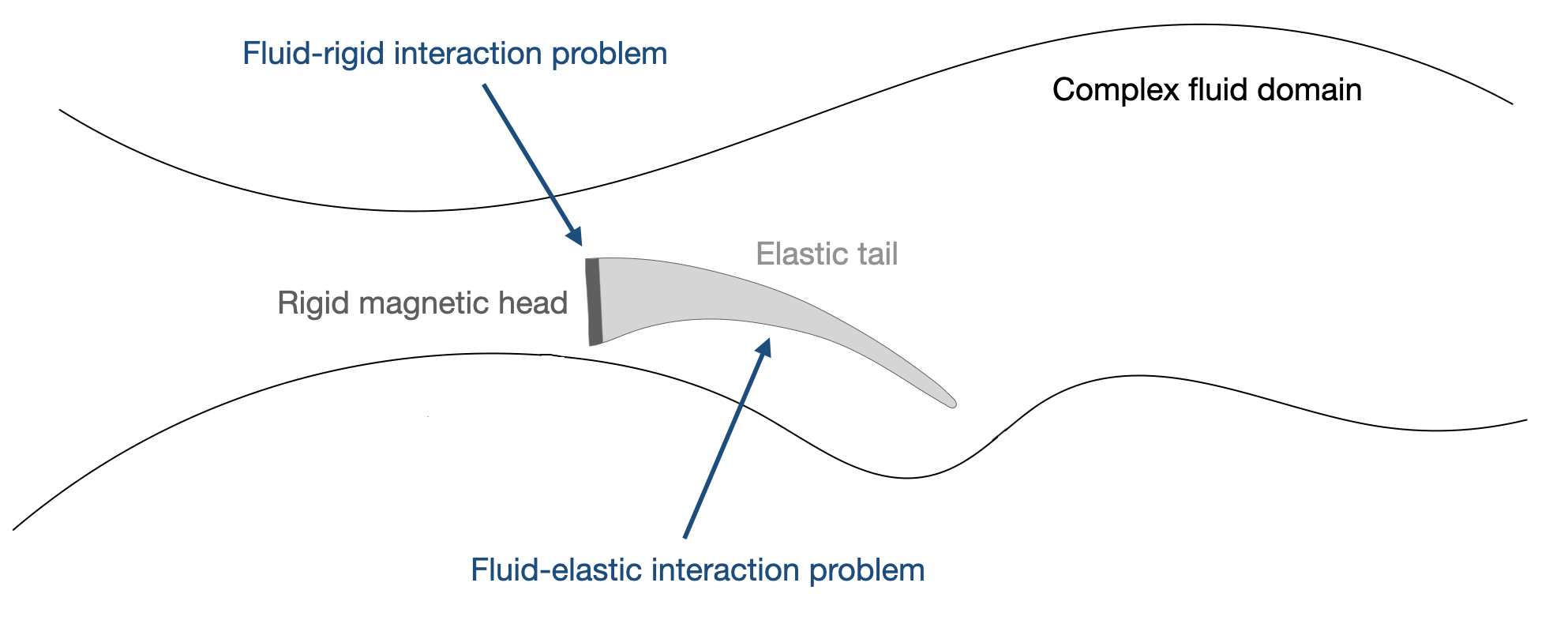
The research studies micro-swimmers in complex and confined environments, including elastic swimmers driven by external magnetic fields. It combines fluid mechanics, numerical simulation and optimisation, with potential medical applications.
Objectives
- Control the micro-swimmer near walls and obstacles.
- Optimise its shape and characteristic parameters.
- Compare numerical results with experiments.
Current research
The research connects micro-swimmer modelling with the multi-fidelity optimisation and high-performance computing methods developed in SAGE-HPC.
Earlier work includes Céline Van Landeghem’s research on micro-swimming in complex environments and the study of magnetic micro-swimmers within ANR NEMO. Current and past support are detailed in the funding section below.
Tools and collaboration
Simulations use Feel++ to model fluid motion and its interaction with swimmers and obstacles. The work connects numerical modelling with the design and control of micro-swimmers.
Historical context
The archived description published on 21 October 2019 presented a magnetic micro-swimmer collaboration between Cemosis, Inria Sophia-Antipolis and the ISIR laboratory. It cited Labex IRMIA and the CNRS InfIniti 2018–2020 challenge as funding for that earlier phase.