
Mathematical and computation framework for moving and colliding rigid bodies in a Newtonian fluid
This paper has been accepted in a forthcoming Special Issue in memory of Prof. R. Glowinski.
Overview
We studied numerically the dynamics of colliding rigid bodies in a Newtonian fluid. The finite element method is used to solve the fluid-body interaction and the fluid motion is described in the Arbitrary-Lagrangian-Eulerian framework. To model the interactions between bodies, we consider a repulsive collision-avoidance model, defined by R. Glowinski in [1]. The main emphasis in this work is the generalization of this collision model to multiple rigid bodies of arbitrary shape. Our model first uses a narrow-band fast marching method to detect the set of colliding bodies. Then, collision forces and torques are computed for these bodies via a general expression, which does not depend on their shape. Numerical experiments examining the performance of the narrow-band fast marching method and the parallel execution of the collision algorithm are discussed. We validate our model with literature results and show various applications of colliding bodies in two and three dimensions. In these applications, the bodies either move due to gravity, a flow, or can actuate themselves. Finally, we present a tool to create arbitrary shaped bodies in complex already discretized fluid domains, enabling conforming body-fluid interface and allowing to perform simulations of fluid-body interactions with collision treatment in these realistic environments. All simulations are conducted with the Feel++ open source library.
Some simulation results
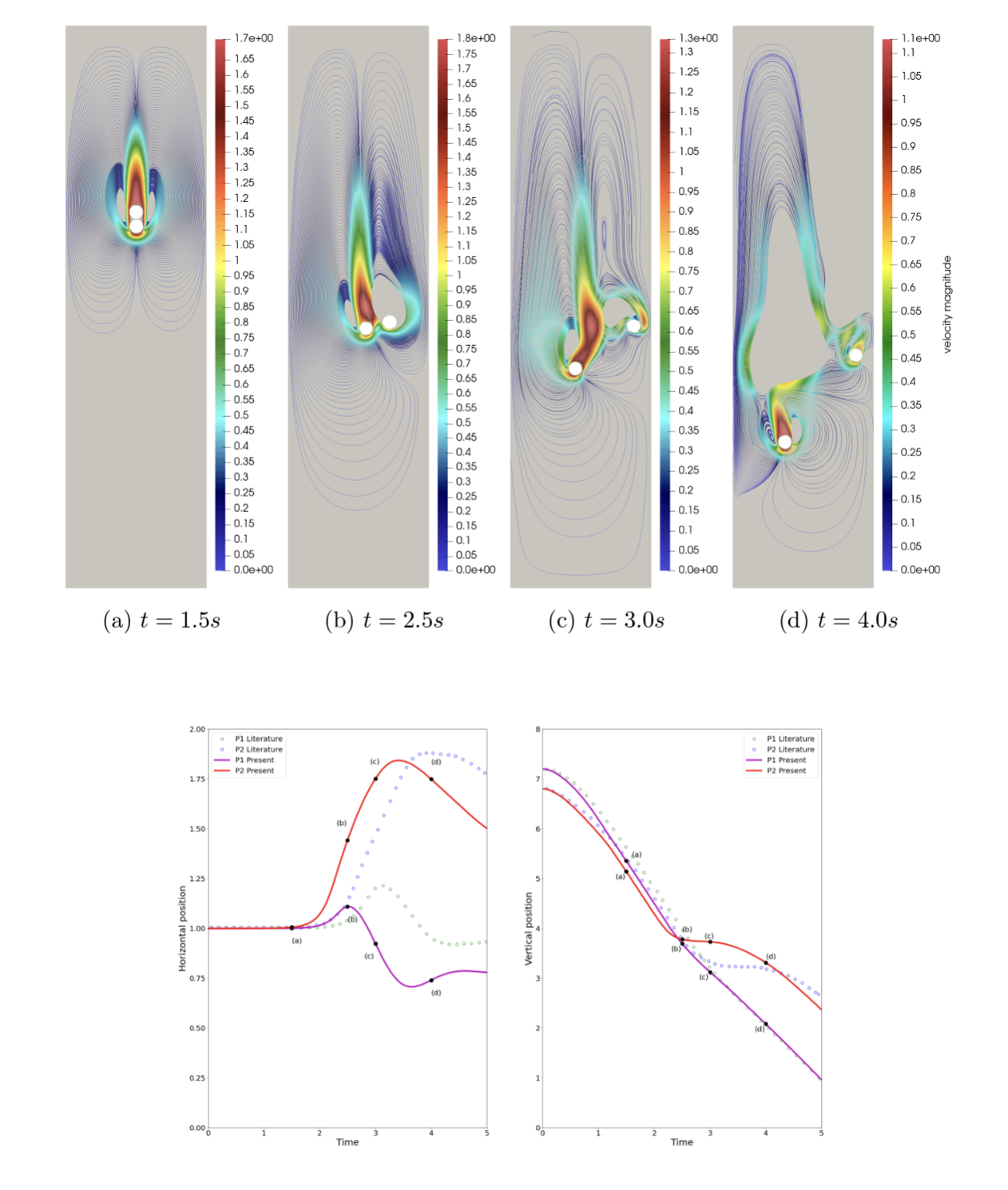
The upper figures show the position of the two disks as well as the streamlines at four different time instants. The lower graphs compare the evolution of the disks horizontal and vertical position to literature [24]. The solid lines correspond to present results and the dotted one to literature results.
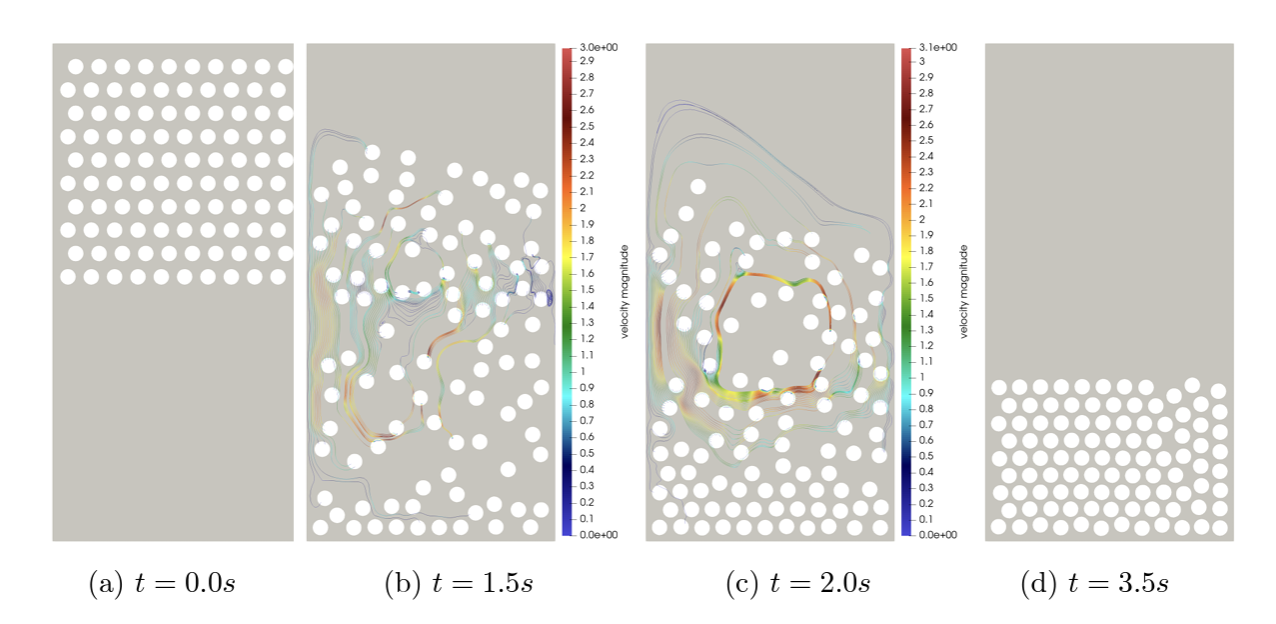
Streamlines and position at four different time instants of 100 disks falling under the effect of gravity in an incompressible Newtonian fluid.
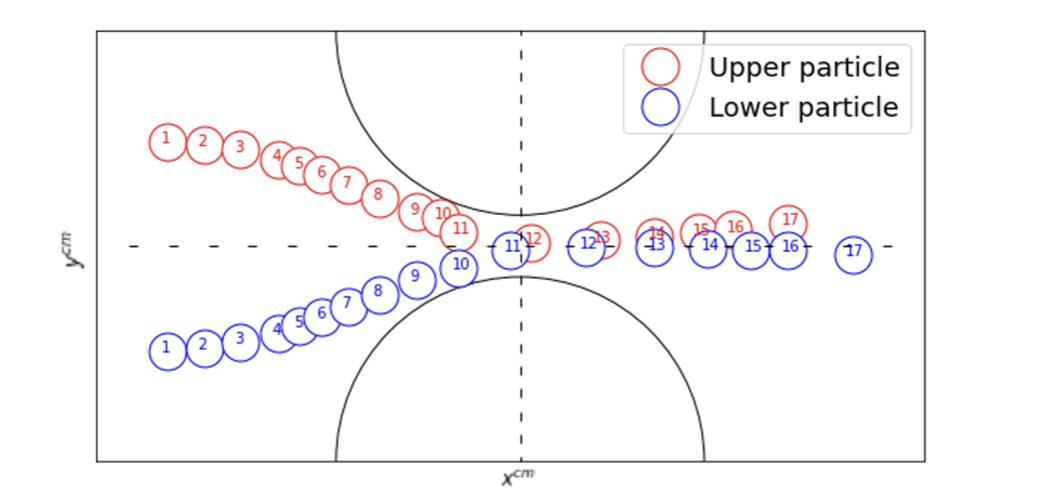
Position of two particles at different time instants in a stenosed artery
Reference
Check out the publication on the Hal Portal